In this story
Imagine a company that can deliver the same output with significantly fewer working hours. Artificial intelligence handles much of its administration, analysis and documentation. Productivity rises. Costs fall. By conventional economic measures, this is progress.
But what happens to the additional value? Will employees earn more or work fewer hours? Will customers pay less? Will the business expand and create different jobs? Or will most of the gains flow to shareholders and technology owners?
All of these outcomes are possible. None is guaranteed by the technology itself.
AI could help improve medicine, accelerate scientific discovery and use energy and materials more intelligently. It could also reduce demand for some kinds of labour, concentrate economic value and stimulate additional consumption. Those possibilities are arriving together, on a planet already under pressure.
Greater productive capacity creates possibilities. It does not decide who benefits from them.
The industrial revolution offers a lesson — and a warning
Mechanisation, electricity and mass production transformed how much people could produce with a given amount of labour. Alongside advances in sanitation, public health and medicine, industrialisation helped make forms of material comfort available that earlier generations could scarcely imagine.
Those benefits came with dangerous working conditions, displacement, pollution and the exploitation of people and natural resources. They were neither immediate nor evenly shared. How workers lived depended on institutions and political choices as well as on what machines could do.
Rising productivity also did not lead societies to conclude that they had produced enough. Cheaper goods encouraged greater consumption. New products created new expectations. Technologies that once seemed remarkable became ordinary necessities.
That history is relevant to AI without being a forecast of its future. If we can accomplish more with less human effort, we have an opportunity to improve public services, reduce exhausting work and gain more time. We can also use that capacity to produce, market and consume more. Technology makes both paths possible; it does not choose between them.
AI and work: exposure is not the same as job loss
Writing, coding, design, research and administration contain tasks that generative AI can assist with or automate. The implications extend well beyond repetitive factory work.
The International Labour Organization’s 2025 occupational-exposure study estimated that one in four workers worldwide was in an occupation with some exposure to generative AI. That is not a prediction that a quarter of jobs will disappear. An occupation is a bundle of tasks, many of which still require human input. The study identifies job transformation as the more likely outcome.
A June 2026 ILO review of empirical evidence found that large-scale displacement remained limited. It also highlighted uneven productivity gains, risks to job quality and concerns about younger workers’ employment opportunities. Findings from the countries and workplaces studied should not be treated as a complete picture of every labour market.
The transition need not involve a sudden wave of dismissals. A company could hire fewer people, leave vacancies unfilled or change what entry-level workers are expected to do. If junior tasks disappear, the route through which people develop expertise may also change. These are possible mechanisms, not proof that every employer is already following them.
Other roles could become more productive, and new kinds of work could emerge. The balance between jobs created, tasks changed and opportunities lost remains uncertain. What is already clear is that a productivity improvement and a broadly shared improvement in livelihoods are different outcomes.
Who captures the gains?
Higher productivity can support lower prices, higher wages, shorter working hours and better services. Whether it does depends on competition, ownership, bargaining power and public institutions.
The Stanford AI Index 2026 reports that industry produced more than 90% of notable frontier models in 2025. This describes one important part of AI development, not ownership of all AI or its entire economic value. Open models, universities and public research remain relevant. But developing and operating leading systems requires access to computing equipment, energy, finance and specialist skills.
Those requirements give an advantage to organisations able to fund large infrastructure investments. If access to that infrastructure shapes who can compete, its ownership matters for the distribution of future returns.
The IMF’s 2024 analysis of fiscal policy and generative AI examines how taxation and social protection could cushion disruption and broaden the gains. It recommends preparing for different scenarios rather than assuming a single inevitable future.
Most households still depend primarily on work for income. If more value can be created with less labour, societies may need to revisit how that value supports economic security. That does not mean abandoning markets or predicting the end of employment. It means asking who receives the savings, who bears the transition costs and whether public institutions can keep up.
Why automate the things people enjoy?
For generations, one promise of automation was relief from exhausting, dangerous or repetitive tasks. Generative AI introduces a different question: why are we also automating stories, music and illustrations — activities people may find meaningful in themselves?
There are good reasons to use these tools. They can help someone express an idea without first mastering every technique needed to realise it. They can make experimentation more accessible. But enabling a person to create and flooding a market with more content are not the same achievement.
A 2024 experiment by Anil Doshi and Oliver Hauser, published in Science Advances, tested access to AI-generated ideas for short stories. AI-assisted stories received higher creativity and writing evaluations, particularly for participants with lower baseline creativity. They were also more similar to one another.
This was a bounded writing experiment, not a verdict on all art or all creative professions. It nevertheless illustrates a tension: a tool can improve an individual’s output while making the collective output less varied.
If the purpose of technology is to expand human possibilities, the process deserves attention as well as the product. Time spent drawing, writing or learning an instrument is not necessarily a cost to eliminate.
The physical footprint behind the digital promise
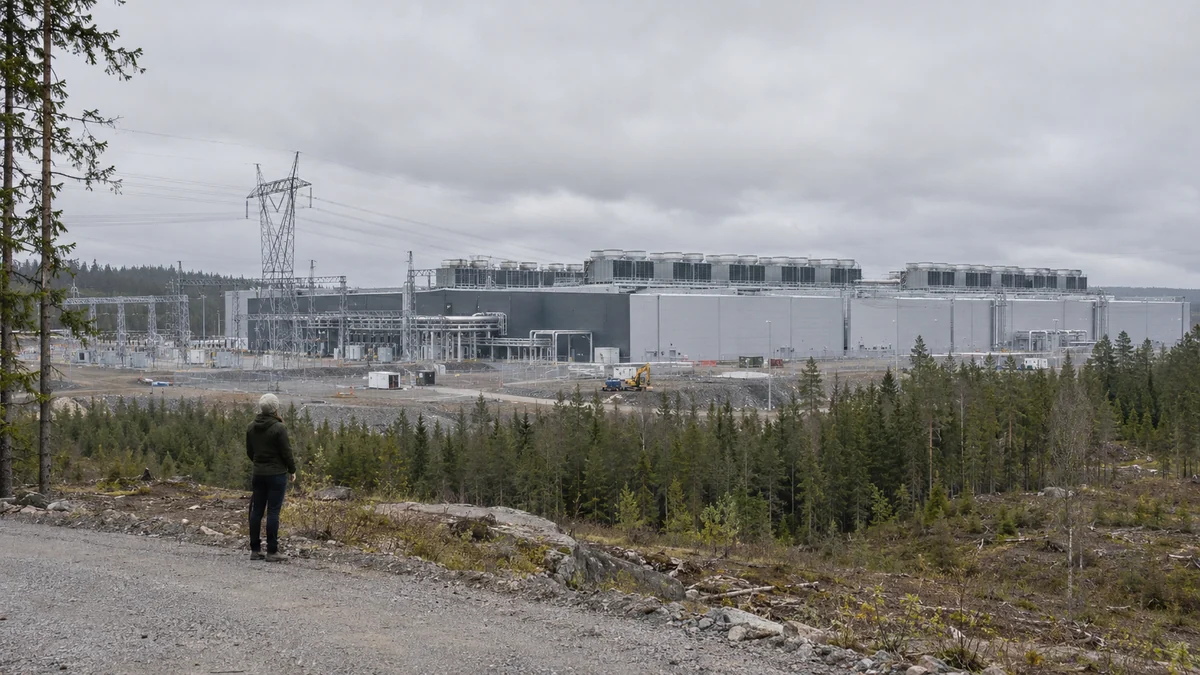
AI runs on infrastructure with a physical address. Buildings, chips, cooling systems and electricity networks require land, materials and construction. The illustration above places a person in front of that physical scale: a large data centre, rooftop cooling equipment, an electrical substation and power lines beyond the trees. It represents the infrastructure behind computing, not the measured footprint of a particular development.
Site choices matter. Reusing an industrial site and clearing a forest are different starting points. A claim about a specific project’s land, water or biodiversity impacts needs local evidence; neither a company-wide energy pledge nor an illustration can supply it.
The IEA’s April 2026 report, Key Questions on Energy and AI, estimates global data-centre electricity consumption at 485 terawatt-hours in 2025. Its central projection reaches about 950 terawatt-hours in 2030. These are figures for data centres overall, not AI alone, and the 2030 figure is a projection rather than a measured outcome.
Energy demand is only part of the picture. Equipment has to be manufactured and replaced; cooling choices and location affect water demand. A meaningful assessment follows construction, operation and eventual equipment disposal, as well as what the computing enables elsewhere.
There are useful applications. The US Department of Energy describes AI-assisted control of plasma instability tested at the DIII-D fusion facility. That is progress in an experimental system, not evidence that commercial fusion power has arrived or will arrive on a particular date.
The same distinction applies to environmental claims more broadly. A promising capability is not yet a measured net benefit. The question is what changes in the world once the system is deployed, including its own resource costs.
Infinite growth, finite planet
Businesses seek growth. Governments depend on economic activity to fund public services. Yet the material systems supporting that activity have limits.
UNEP’s Global Resources Outlook 2024 reports that global resource extraction has tripled over five decades. Without substantial changes, it projects a further increase of around 60% between 2020 and 2060. That is a scenario to change, not an unavoidable destiny.
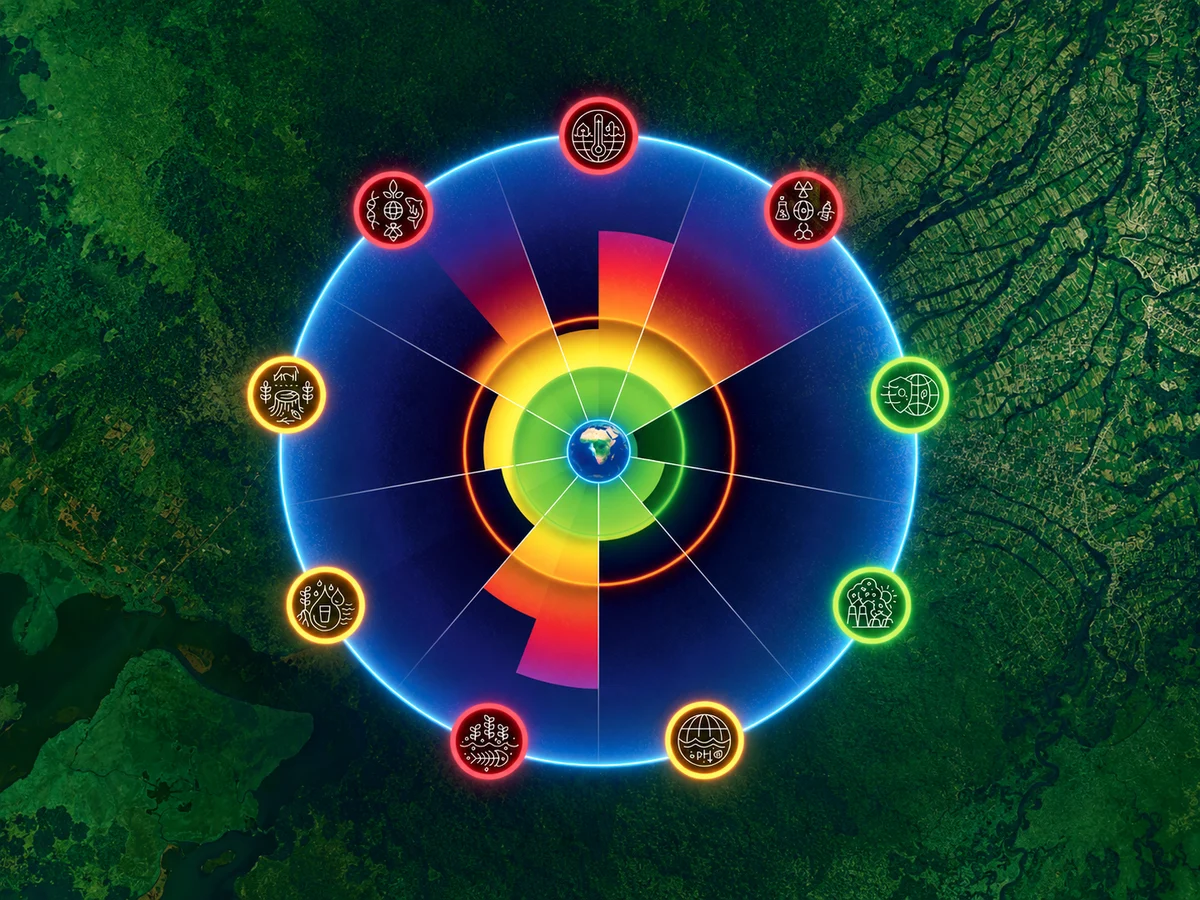
The Planetary Health Check 2026 identifies seven of nine planetary boundaries as transgressed. These boundaries concern processes supporting Earth-system stability, including climate, biodiversity, land, freshwater, nutrient cycles and ocean acidification. Crossing one does not mean instant collapse; it signals increased risk beyond a scientifically assessed safe operating space. Our feature on the connected planetary crises explains why these pressures cannot be treated in isolation.
Economic value and material throughput are not identical. Better healthcare, education or software can increase value without a proportionate increase in physical consumption. But the possibility of doing so does not demonstrate that global environmental pressures are falling far enough or fast enough.
The useful test is therefore more demanding than whether an economy grows. Can well-being improve while total pressure on natural systems falls? AI could help, but faster computation does not settle the question.
Efficiency is not the same as using less
More efficient equipment needs fewer inputs per unit of output. That is valuable. Yet lower costs can also encourage greater demand, offsetting some of the savings — the rebound effect. Its scale varies; efficiency gains are not always completely cancelled out.
Consider a simple illustration. A factory cuts material use per product by 20%, then doubles production. At unchanged product mix, total material use rises by 60%: twice as many units multiplied by 80% of the former material requirement. Each product is more efficient; the system uses more material.
AI could improve process control, reduce defects and help planners avoid unnecessary production. It could also speed up product development and advertising, encouraging additional demand. Which effect dominates depends on the application and the conditions around it.
The test is not only whether AI makes each task cheaper. It is whether the resulting system uses less to meet real needs.
This is why environmental reporting needs absolute quantities alongside efficiency ratios. Electricity per computation, material per product and emissions per euro can all improve while total consumption continues to rise.
Can AI help close material loops?
Material discovery, equipment maintenance, sorting and supply-chain planning are plausible places to put AI to useful work. Better predictions can help focus experiments, identify faults or match recovered materials with demand. These are applications to evaluate, not a guarantee of environmental savings.
The gap remains substantial. Eurostat reports that recycled sources supplied 12.2% of the materials used in the EU in 2024. This circular material use rate measures recycled material’s contribution to overall use; it is not the percentage of all waste that was recycled.
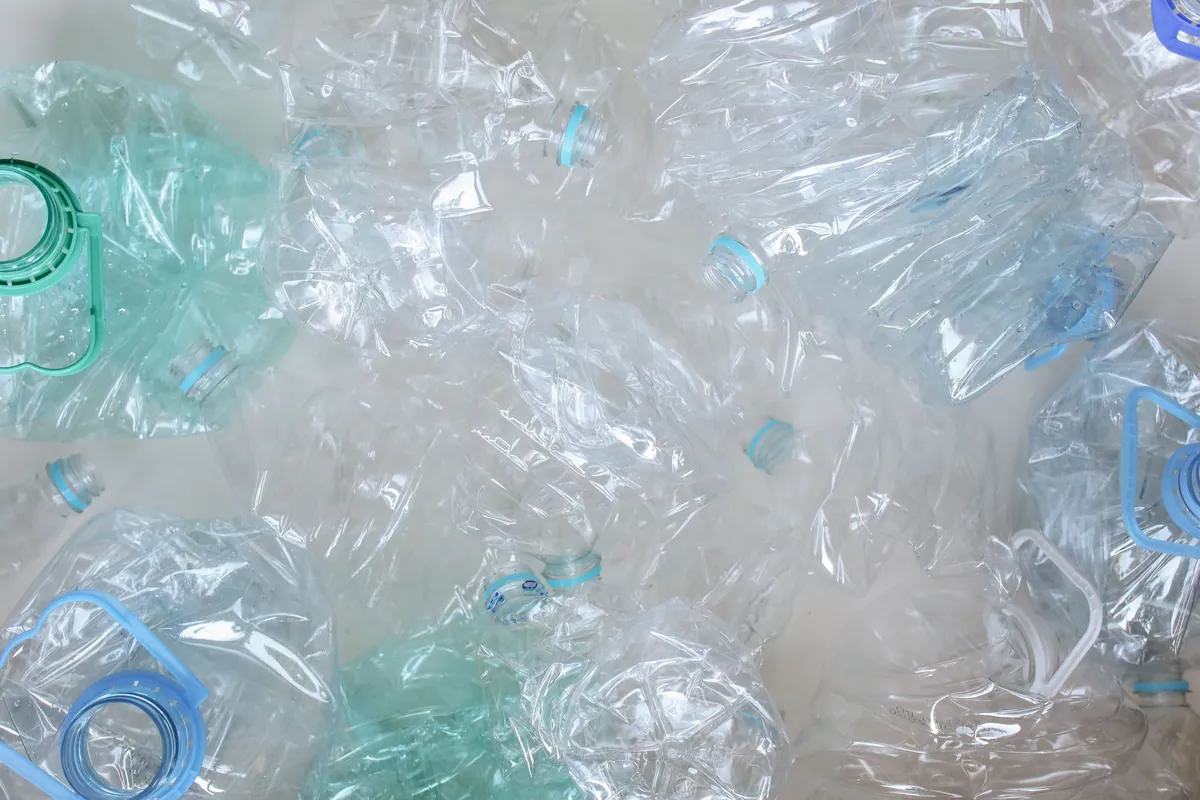
Nor does recycling capture all of circularity. Durable design, repair, reuse and avoiding unnecessary production can reduce demand before a recycling facility becomes relevant. Our analysis of recycled-plastic economics follows the collection, quality and market conditions needed to turn a technical possibility into a working loop.
For an AI-enabled system, the questions should be equally practical. Does it extend a product’s useful life? Does recovered material actually displace virgin material? Does the improvement survive when the energy, equipment and extra demand it creates are counted?
An efficient system is not automatically a sustainable one.
What would less necessary work make possible?
If societies can meet more needs with fewer working hours, the gains could take several forms. Some people might work less. Others might move into care, education, maintenance or new activities. Businesses might expand. Outcomes will vary between sectors and countries.
Policy options discussed around automation include retraining, income protection, shorter working hours, employee participation in productivity gains and changes to taxation. Universal basic income is another proposal, but a meaningful and reliable payment requires funding and choices about what it complements or replaces. No single measure resolves every distribution problem.
The broader point is that employment, income and security do not have to remain organised in exactly the same way as capabilities change. Nor should a possible future of less work be used to dismiss the immediate importance of stable, decent employment.
GDP helps measure economic activity. It does not directly tell us whether people have more time, whether gains are fairly shared or whether ecosystems are healthier. Those outcomes need their own measures.
Development needs also differ. Many communities still need more housing, electricity, sanitation and essential infrastructure. A sustainable future cannot mean asking everyone to consume less regardless of their circumstances. It must ask what is being expanded, for whom and at what environmental cost.
The technology is not the outcome
AI could help people discover medicines, improve services, reduce waste and avoid dangerous work. It could also increase material demand, weaken some employment opportunities and concentrate rewards. These developments can occur at the same time.
That is why neither an unqualified promise of abundance nor a prediction of inevitable disaster is sufficient. The important decisions concern ownership, incentives, infrastructure and the purposes to which new capabilities are put.
Progress would mean more than producing more content, more products or more economic output. It could mean better lives, more security and time, and less damage to the natural systems supporting both.
AI could change everything. But for whom — and towards what kind of future?
Editorial note: This is an analysis of research and possible policy choices, not a prediction of net job losses or a quantified environmental balance for AI. Study results, observed data and projections are distinguished in the text. The lead illustration was supplied by Ocean Material, whose team is also behind Moana Earth. It does not establish the conditions or environmental impacts of a specific site.
Sources and further reading
- ILO — Generative AI and Jobs: A Refined Global Index of Occupational Exposure (2025).
- ILO — The impact of GenAI on jobs, productivity and work organization: a review of the empirical evidence (2026).
- IMF — Broadening the Gains from Generative AI: The Role of Fiscal Policies (2024).
- Stanford HAI — AI Index Report 2026.
- Doshi and Hauser — Generative AI enhances individual creativity but reduces the collective diversity of novel content (2024), Science Advances, 10(28).
- IEA — Key Questions on Energy and AI (2026).
- US Department of Energy — AI Tackles Disruptive Tearing Instability in Fusion Plasma (2025).
- Planetary Health Check 2026.
- UNEP / International Resource Panel — Global Resources Outlook 2024.
- Eurostat — Over 12% of materials in the EU come from recycling (2025; 2024 data).