In this story
You open a drink, and the attached cap gets in the way. You turn it aside and try to take a sip. It is one of the rare environmental rules you can feel every time you use a product. That everyday irritation is real. So is a larger one: the design of a small plastic part gets intense attention while the fate of the whole bottle remains far less visible.
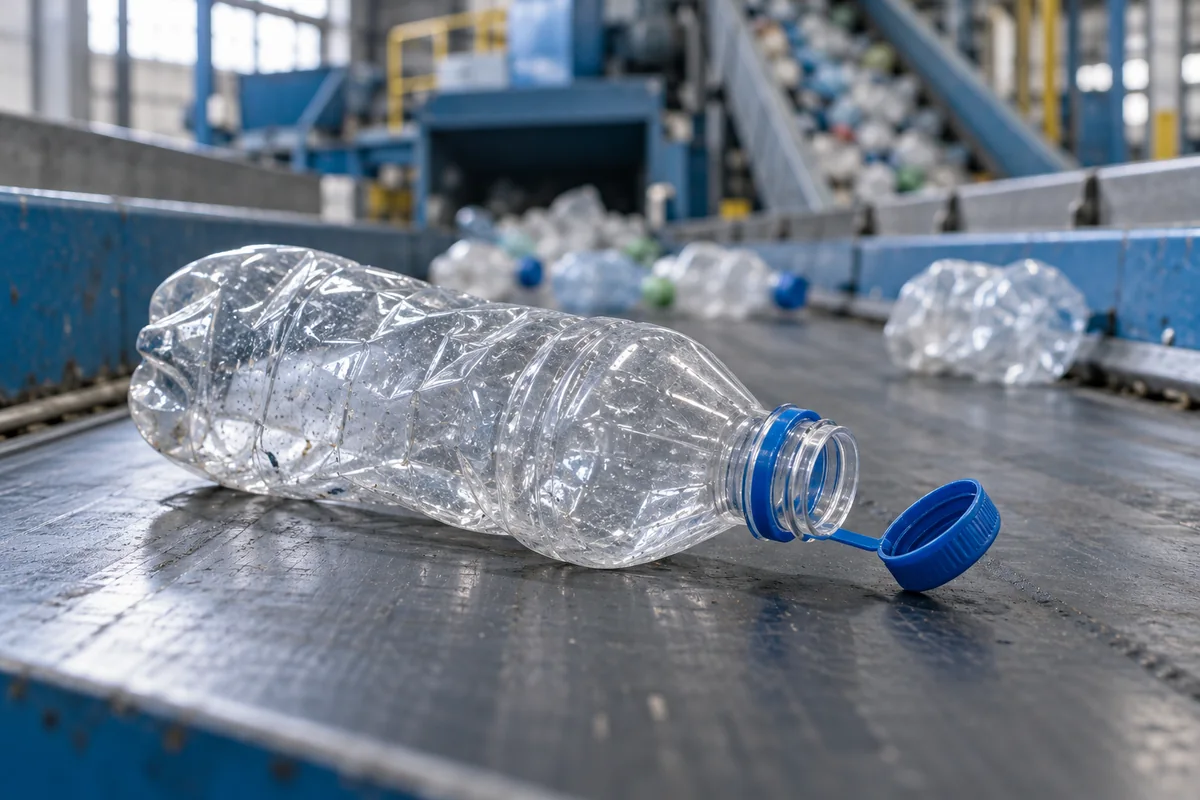
That irritation now meets a second cap story. Three of the world’s best-known drinks companies have agreed to make a small correction to a very large promise. Where a bottle is described as made from “100% recycled plastic”, Coca-Cola, Nestlé Waters and Danone have committed to make clear that the figure excludes the cap and label. They have also agreed to drop wording that could suggest a bottle will inevitably become another bottle. The European Commission set out the commitments after a consumer-group complaint and discussions with the companies.
Consumers deserve that precision. If a statement refers only to the bottle body, it should say so. But it would be a mistake to confuse a more accurate sentence with a solution to packaging waste.
The timing makes the gap hard to ignore. On 22 October 2026, the day the final company commitment was announced, Eurostat published its latest packaging figures. In 2024, the EU generated 81.5 million tonnes of packaging waste, or 181 kilograms per person. That was 3.2 kilograms more per person than in 2023 and 19.6 kilograms more than in 2014. Plastic packaging alone accounted for 35.9 kilograms per person in 2024; 42.4% of it was recycled. Both the amount generated and the amount recycled rose from the previous year.
Those figures describe 2024, before the EU’s new packaging and consumer-claims rules began to apply. They cannot tell us whether those rules are working. They do tell us what the rules have to overcome: a system that has become better at describing and processing waste while producing a great deal of it.
A claim can be corrected in a meeting. A material loop has to work every day.
Two cap debates, one bigger question
The attached cap and the corrected claim answer different questions. Since 3 July 2024, EU rules have required plastic caps to remain attached during the intended use of certain single-use drinks containers. The aim is to reduce loose caps becoming litter; the rule came from the Single-Use Plastics Directive, years before the latest announcement about recycling claims. It does not tell consumers to pull caps off for recycling.
The design rule has a sound reason: caps are small and easily lost, and the European Commission identified them as a common item on beaches. An awkward drinking experience is a reason to improve the design, not evidence that the rule has failed or that removing caps improves recycling. Likewise, leaving a cap attached does not prove a bottle is circular.
Both debates are worth having. Neither tells us whether fewer disposable packages are made, whether collection systems work, or whether recycled material replaces virgin plastic. That is the question large enough to match the problem.
Truth on the label is the floor
The bottle case matters. “100% recycled” sounds like a statement about the whole object, not just one component. “Recycle me again” can suggest a closed loop that may not exist for a particular bottle. Consumer authorities should challenge claims that leave people with the wrong impression.
Yet the environmental result does not change when the wording changes. The cap is still made, the bottle is still sold, and all of its parts still need a route after use. A corrected label does not tell us how many bottles are placed on the market, how many are returned, what share becomes new bottles, or how much virgin material the system still requires.
This is the distinction between information and outcome. Both matter. One should not be offered as proof of the other.
If we celebrate this correction as an environmental victory, we lower the bar to a change of wording. An industry can describe every disposable package accurately and still put more of them on the market. The uncomfortable test is whether it can depend on fewer.
This is a pattern that reaches beyond bottles. People can see a new cap and read a revised percentage. They cannot see how much virgin plastic a company bought this year, or what happened to plastic after collection. A visible improvement can become the whole public story while the quantities and incentives behind it barely change. The editorial question is simple: which underlying numbers moved?
The question is how much material passes through
Packaging is often discussed one item at a time: the bottle, the cap, the wrapper, the tray. The system works at a different scale. Each purchase depends on materials being extracted, converted, filled, distributed, collected and handled after use. A package may become lighter or easier to recycle while the number of packages sold keeps growing. Better design can then coexist with more waste.
That is why an honest accounting of progress must start with total material throughput. Are fewer single-use packages entering the economy? Are packages being used again in practice, not merely described as reusable? Is demand for virgin material falling? How much of the material collected returns to a useful application, and at what quality?
The new EU Packaging and Packaging Waste Regulation does address more than labels. It includes requirements on packaging design, reuse and recycled content, with measures taking effect in stages. Its waste-prevention target requires each member state to cut packaging waste generated per person by at least 5% by 2030 compared with 2018, then 10% by 2035 and 15% by 2040. The serious debate is whether implementation and market conditions will deliver those reductions, not whether the legislation contains them.
The newer consumer rules serve another purpose. The EU’s Empowering Consumers for the Green Transition Directive, known as EmpCo, tightens the rules on vague environmental claims and sustainability labels from September 2026. The bottle commitments arose from a complaint made in 2023 under existing consumer-protection processes; they should not be presented as an EmpCo enforcement case. Packaging design, waste prevention and the truthfulness of advertising are related problems, but they are different tests.
“Recyclable” is not a destination
In Why Recyclable Packaging Is Not Enough, Ocean Material founder Toni Kienberger described a weakness that applies far beyond his company: making something technically recyclable does not ensure it will be collected, sorted, processed and bought as a new material. Recycling needs infrastructure and a customer for its output. It also has to compete economically with virgin material.
That is a useful challenge to apply to any company’s claim, including Ocean Material’s. Where is the material actually collected? Who can process it at scale? What proportion becomes usable output? Who buys it, and does that use replace virgin material or simply add another product to the market? None of these questions is answered by a recycling symbol.
The European Commission has itself warned that plastics recyclers face high costs, volatile virgin-plastic prices, cheap imports and weak demand for recycled material. If recycling capacity struggles while targets rise, designing more objects to be “recyclable” will not, by itself, close the loop.
The difficulty of closing that loop is explored further in our analysis of why good plastic still becomes bad recycling.
What happens when the price signal points the wrong way?
A proposed German plastics tax puts that question into money. A draft dated 30 September 2026 would charge €550 per tonne of plastic in covered packaging for taxable events after 30 June 2027. It provides for relief on the recycled share, but as a later refund on application. The conditions and proof system would be set by a future regulation; the draft gives no date for that system to be ready. As of a 16 October government briefing, talks were still continuing. This is a proposal, not a tax already in force.
If it took effect before the relief mechanism, a producer using recovered plastic could initially face the same charge per kilogram as one using virgin plastic. That would be a strange opening signal for a policy that says it wants more recyclate. The draft’s stated first purpose is to raise federal revenue broadly equal to Germany’s contribution to the EU plastics budget. Yet the EU contribution is calculated on plastic packaging waste that is not recycled, while the proposed German tax would be based on plastic put into covered packaging. Those are different measures.
The answer is not necessarily to abandon a packaging tax. It is to design it so the circular option is rewarded from day one, and to test its effect on total packaging volumes as well as the market for recovered material. Otherwise the state can collect the revenue while the material system keeps running much as before.
The ocean does not read the label
Packaging waste becomes a marine issue when it escapes collection and reaches waterways, coasts or the sea. The European Environment Agency describes rivers, stormwater, sewage and wind as pathways for litter. Preventing that leakage matters. So does reducing the volume that must be managed in the first place.
We should not claim that rising packaging waste means marine litter is rising everywhere. The EEA reports that monitored macro-litter along EU coastlines fell by 29% between 2015–2016 and 2020–2021. That is evidence that targeted action can make a difference. It is not a reason to stop asking what happens before a package reaches a bin or a beach.
An ocean-facing packaging policy needs to be judged by both ends of the chain: the amount of material placed on the market and the amount that escapes into nature. A better claim on a bottle can help a buyer understand it. It cannot do either job on its own.
What would count as a win?
The next victory headline should be harder to write. Ask the companies for their absolute packaging volumes and virgin-plastic use, not only the recycled share of a selected bottle. Ask policymakers whether total waste is falling and whether their rules make recovered material economically viable. Ask how much packaging escapes collection and reaches waterways. A corrected label can coexist with uncomfortable answers to every one of those questions.
None of this makes truthful labels trivial. It puts them in proportion. Clear information is a minimum condition for accountability. It is not the environmental result we came for.
The cap may be excluded from the recycling claim. It cannot be excluded from the system.
Sources & editorial notes
- European Commission, consumer-protection action on recycling claims for plastic bottles; BEUC, statement on the three company commitments, 22 October 2026.
- European Union, Single-Use Plastics Directive, Article 6(1), on caps remaining attached during intended use; European Commission, explanation of the cap requirement and its litter-prevention purpose.
- Eurostat, Plastic packaging waste in the EU: 35.9 kg per person, 22 October 2026. Its waste figures cover the whole economy, including household, business and government packaging. They refer to 2024 and are not an assessment of rules that began to apply in 2026.
- European Union, Regulation (EU) 2025/40 on packaging and packaging waste, especially Article 43 on per-capita waste-prevention targets; European Commission, overview of the staged application of the regulation.
- European Commission, EmpCo consumer rules and their application date. The 2023 bottle complaint and resulting voluntary commitments should not be conflated with enforcement of the newer directive.
- European Commission, 2025 communication on structural pressures facing EU plastics recyclers.
- Proposed German Kunststoffverpackungsteuergesetz, draft dated 30 September 2026, published by Packaging Journal, especially the proposed rate, start date, recycled-content relief and explanatory memorandum; German government briefing, 16 October 2026, confirming talks were ongoing. The draft is not enacted law. European Commission, basis of the EU plastics own resource.
- European Environment Agency, marine-litter pathways and EU coastline macro-litter trends. Packaging-waste totals must not be treated as a measure of litter entering the sea.
- Ocean Material interviews with Toni Kienberger: Rethinking Plastic Recycling, 4 November 2025 and Why Recyclable Packaging Is Not Enough, 11 August 2026. Moana Earth was created by the team behind Ocean Material. The interviews inform the questions raised here; the reported figures and policy descriptions above are checked against independent or official sources.